Key Takeaways
- Agentic AI shifts software from responding to actively executing tasks.
- Real business value comes from completing workflows, not just generating outputs.
- Strong integration is essential to connect AI with real enterprise operations.
- Enterprise systems are evolving from fixed automation to dynamic orchestration.
Over the past few years, generative AI has moved rapidly from experimentation to everyday business use. Organizations have widely adopted AI assistants to generate content, summarize information, and support decision-making. Yet despite this progress, most enterprise deployments still rely heavily on human prompts and manual follow-up. AI excels at responding but remains limited in its ability to independently advance work.
A new shift is now emerging, one that moves beyond assistance toward autonomous execution. Instead of systems designed only to respond, businesses are exploring intelligent agents capable of interpreting objectives, planning tasks, and acting across systems. This model, increasingly known as Agentic AI, is redefining what enterprise software is expected to do.
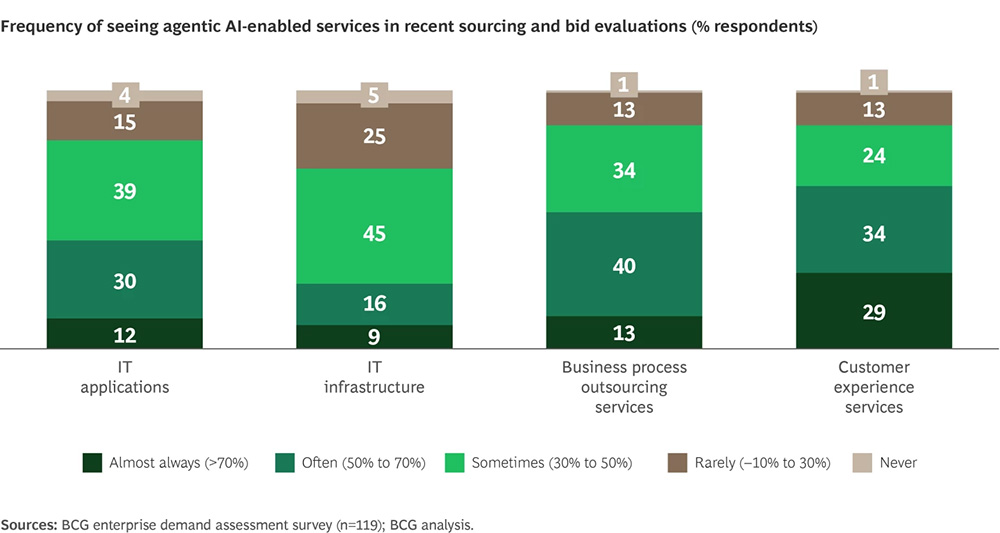
Sources: BCG enterprise demand assessment survey (n=119); BCG analysis.
From Assistance to Autonomous Action
The first wave of enterprise AI focused largely on copilots and conversational interfaces. These tools improved productivity by accelerating tasks such as:
- Drafting emails
- Summarizing documents
- Generating recommendations
- Answering internal queries
Their value was immediate, but their logic remained simple: a user initiates, and the system responds.
Agentic AI introduces a different operating model. Rather than waiting for instructions at every stage, intelligent agents can work toward a defined goal and determine how to move forward. A single request may trigger multiple actions, including retrieving information, evaluating conditions, interacting with software tools, and adjusting decisions as new inputs emerge.
This changes AI from a productivity layer into an execution layer. In practical terms, several specialized agents may operate within one workflow, each handling a specific function while contributing to a broader objective.
15% of day-to-day work decisions will be made autonomously through agentic AI by 2028, up from none in 2024 *
* Gartner
Why Enterprises Are Looking Beyond Generative AI
As organizations mature in their AI adoption, many are recognizing that generating outputs does not automatically translate into operational value. Producing content is useful, but enterprise performance depends on whether systems can help complete work across processes, decisions, and departments.
This is where agentic AI becomes strategically relevant. Instead of stopping at insight or recommendation, intelligent agents can support multi-step business processes such as:
- Onboarding journeys
- Internal approvals
- Service resolution
- Compliance validation
- Customer follow-up
The value shifts from producing answers to advancing execution.
For enterprises, this begins to address a long-standing operational gap: the distance between decision and action. Information may already exist inside systems, yet progress often depends on someone manually connecting context, validating inputs, and initiating the next step. Agentic systems reduce that friction by linking intelligence more directly to workflow.

Integration Is Where the Real Challenge Begins
Autonomous capability alone does not create enterprise value. For agentic AI to operate effectively, it must function inside the environments where work actually happens. That requires interaction with:
- Enterprise applications
- APIs
- Business logic
- Operational rules
- Secure data sources
An intelligent agent may detect that a customer onboarding file is incomplete, but acting on that insight requires access to document workflows, validation logic, communication channels, and escalation paths. Without integration, intelligence remains disconnected from execution.
This is why integration is becoming one of the defining challenges of the agentic enterprise. In enterprise environments, the true value of intelligence lies in its ability to connect decisions with systems safely, reliably, and at scale.
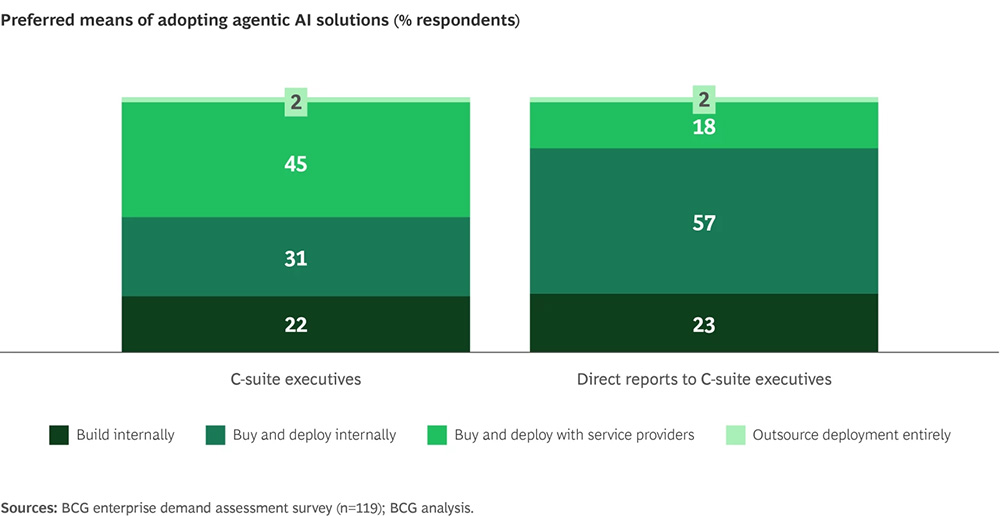
Sources: BCG enterprise demand assessment survey (n=119); BCG analysis.
Agentic AI in Practice: A Real-World Workflow
To understand the impact of agentic AI, consider a customer onboarding process in a financial institution.
Traditionally, onboarding spans multiple systems and teams. Documents are submitted, verified, checked against compliance rules, and often escalated manually. Even when partially automated, the process remains sequential and dependent on human coordination.
With an agentic approach, this workflow becomes more dynamic and adaptive through coordinated intelligent agents:
- one agent validates submitted documents
- another checks compliance requirements
- another detects missing or inconsistent data and triggers follow-ups
- another prepares escalation cases when risk is identified
Instead of following a fixed sequence, the system continuously evaluates the situation and determines the next best action. It can request data, route cases, or escalate issues without waiting for manual intervention.
This illustrates how agentic AI moves beyond task automation and enables more responsive, outcome-driven workflows.
33% of enterprise software applications will include agentic AI by 2028, compared with less than 1% today *
* Gartner
Governance, Trust, and the Digital Workforce
As systems gain more autonomy, trust becomes central. Before intelligent agents can operate confidently inside enterprise environments, organizations must address practical questions:
- Who approves agent decisions?
- How are actions monitored and audited?
- How is compliance maintained when agents act across systems?
- What happens when an agent encounters ambiguity or conflicting inputs?
These are not purely technical concerns. They directly influence adoption.
This is especially critical in regulated environments, where every action must remain visible and accountable. The challenge is not simply enabling autonomy but ensuring that autonomy operates within clearly defined boundaries.
For this reason, the future is increasingly described as building a digital workforce in which human teams and intelligent agents collaborate. The strongest models will likely combine:
- Machine-led execution for repetitive and structured tasks
- Human oversight for judgment, escalation, and strategic decisions

Building the Next Enterprise Layer
For organizations moving beyond experimentation, success will depend on three foundations:
- Integrated architecture
- Orchestration capability
- Governance
These are becoming the core building blocks of the next enterprise AI layer. Rather than adding isolated features, businesses are rethinking how intelligence operates directly within workflows.
Platforms such as Agentiks reflect this shift by enabling organizations to orchestrate intelligent agents across real enterprise environments, where actions must remain secure, contextual, and scalable. These agents can support functions such as customer onboarding, service interactions, internal operations, compliance checks, and decision support, helping transform routine processes into more adaptive execution.
This is where agentic AI moves from concept to real enterprise value.
Conclusion
Agentic AI represents more than the next stage of artificial intelligence. It signals a broader shift in how enterprise systems are designed to function.
Software is no longer expected only to respond when prompted. Increasingly, it is being built to understand objectives, coordinate actions, and contribute actively to execution.
The organizations that benefit most from this shift will be those building the operational foundations for autonomous workflows that are integrated, governed, and trusted.
The future of enterprise technology may not be intelligent software; It may be software that acts.