Key Takeaways
- Not everything should be automated; tasks requiring creativity, empathy, or complex judgment are best left to people.
- Over-automation carries hidden costs, from rigidity and maintenance burdens to reduced employee morale.
- AI expands automation’s potential, enabling adaptive, data-driven processes, but it still falls short in ethics, context, and transparency.
- Balance is the key to success; the most effective organizations design hybrid systems where automation and AI enhance human work, but don’t replace it.
Introduction
In our earlier article Task Automation in the Workplace (Part 1), we explored what task automation means, its benefits, and how to implement it effectively. In the rush to embrace task automation, most organizations focus on the obvious: ‘what’ can be automated and ‘how fast’ they can do it. But the less glamorous question ‘What should not be automated?’ often gets overlooked. At the same time, artificial intelligence is expanding what’s possible, while also blurring the line between smart efficiency and potential risk.
As we move deeper into the era of AI-driven automation, success depends not only on implementing powerful tools but also on exercising judgment. Knowing when to hold back is just as valuable as knowing when to press forward.

What Not to Automate
Unstable or evolving processes
Automating a process that isn’t fully defined or is frequently changing often creates more problems than it solves. If rules and requirements shift every few weeks, an automated system quickly becomes outdated, forcing constant fixes. In these cases, it’s wiser to stabilize the workflow first, then consider automation.
Tasks requiring creativity or human judgment
Strategic planning, complex negotiations, or empathetic conversations with clients demand qualities like creativity, nuance, and emotional intelligence. Automating these areas risks reducing outcomes to formulaic responses that miss the human touch.
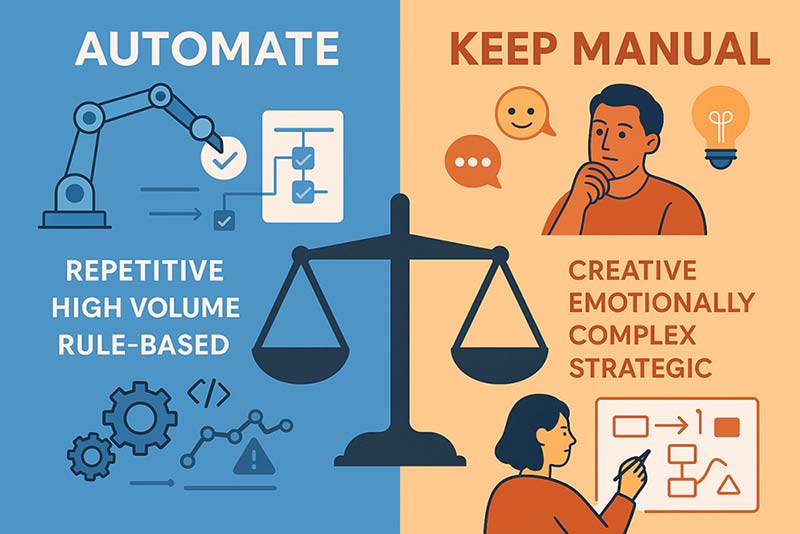
Source: Test Automation Tools
High-stakes or regulated activities
Industries like healthcare, finance, and law rely on accuracy, accountability, and transparency. Errors in these domains carry serious consequences, from regulatory penalties to damaged reputations. While automation can support professionals by handling routine checks or data management, final decisions in critical matters are best left to human oversight.
Rare or infrequent tasks
Some activities occur so rarely that automating them costs more than it saves. If a process is performed only once every few months, the setup and maintenance of automation may outweigh its value. Manual execution may remain the smarter, leaner option.
Edge cases and exceptions
Automation shines in structured, repetitive processes. But when exceptions and unusual scenarios dominate, systems often stumble. Designing automation to cover every outlier not only increases complexity but also makes the workflow fragile. In such cases, flexibility and human adaptability outperform rigid code.
The global marketing automation market is projected to grow from $5.65 billion in 2024 to $14.55 billion by 2031 at a CAGR of 12.55% *
* Verified Market Research
The Hidden Risks of Bad Automation
Misapplied automation doesn’t just underperform; it can create liabilities.
Loss of adaptability
Too much reliance on automation can make organizations rigid. When markets, regulations, or customer expectations change, automated processes can become barriers to agility instead of drivers of it. Flexibility is lost when workflows are locked into automated routines.
Ongoing maintenance burdens
Automation is not a one-time project. Systems require updates, patches, and troubleshooting as technology and processes evolve. Over time, the cost of maintaining these workflows can erode the savings they were designed to deliver.
Over-reliance and blind trust
Humans are prone to “automation bias, assuming that automated results are always correct. This misplaced trust can let errors slip through unnoticed, with consequences that multiply across systems and teams. Continuous monitoring and validation are essential safeguards.
Impact on employees
When automation removes human input from meaningful work, morale can suffer. Employees may feel sidelined, undervalued, or disconnected from their contributions. A healthy approach involves positioning automation as a partner that removes drudgery, not as a replacement that strips purpose from people’s roles.

The Role of AI in Task Automation
Traditional automation excels at repeatable, rule-based tasks. AI, however, brings new dimensions by handling variation, learning from data, and adapting to new patterns. Its influence on task automation is profound, but so are its limitations.
What AI makes possible
AI can interpret messy, unstructured information such as natural language, images, or free-form text. It can predict outcomes, detect anomalies, and offer recommendations at a scale and speed humans cannot match. Generative AI now allows businesses to draft content, summarize documents, and interact with customers more naturally than earlier chatbots.
Where AI falls short
Despite its power, AI struggles in areas requiring deep context, values, or ethical judgment. It cannot explain its reasoning in clear, human terms, creating risks of bias and opacity. Rare scenarios, unexpected data, or adversarial inputs can easily throw AI off track. Businesses must remember that AI’s intelligence is not the same as human judgment.
Human + AI synergy
The real opportunity lies not in entirely handing tasks over to AI but in designing hybrid systems. In these models, AI handles the heavy lifting (processing vast amounts of data, surfacing insights, or drafting first versions) while humans provide interpretation, decision-making, and accountability. This “human in the loop” approach balances efficiency with trust.
Best Practices for Deciding What to Automate
Organizations should evaluate candidates for automation using a clear decision framework.
- Stability: Is the task stable enough to justify automation, or is it constantly evolving?
- Frequency: How often does it occur, and is the volume high enough to deliver real savings?
- Cost vs. value: Do the benefits outweigh the setup, monitoring, and maintenance?
- Risk profile: What happens if the system fails? What are the consequences of errors?
- Human value: Does the task involve empathy, creativity, or strategic thinking best preserved by people?
Practical implementation also matters. Start small with pilot projects, then scale once results are proven. Measure success in terms of cost and error reduction, adaptability, and employee satisfaction. Involve stakeholders across the organization to surface risks and opportunities early. And finally, plan for the long haul: automated systems and AI models require monitoring, retraining, and continuous refinement to remain effective.
Conclusion
Automation is a powerful driver of growth and efficiency, but it is not a universal solution. Knowing where to draw the line is just as important as knowing where to push forward. The most effective organizations treat automation as a tool to free employees from repetitive work while deliberately keeping tasks that require creativity, empathy, and judgment in human hands.
As AI reshapes what is possible, the frontier of automation will continue to expand. But success will not be measured by how much work we automate; it will be measured by how wisely we balance machine efficiency with human capability. The future of work is not automation alone; it is a partnership where humans and machines each play to their strengths.